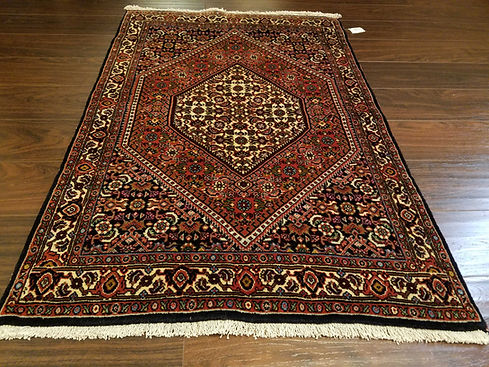
About Bidjar Rugs
Bidjar / Bijar
Bijar, Iran: History and Economic Landscape
Nestled in the Kurdish region of northwestern Iran, Bijar is a city with deep historical roots and a reputation for exceptional craftsmanship. Often referred to as the “Crown of Kurdistan,” Bijar has been a cultural crossroads for centuries, shaped by Persian, Kurdish, and Azerbaijani influences. Its strategic location along old trade routes helped it flourish during the Safavid and Qajar eras, when merchants, nomads, and artisans contributed to its diverse cultural and economic life.
Bijar is especially renowned for its long-standing tradition of rug weaving. The city’s hand-knotted carpets — famously known as Bijar rugs — have earned global recognition for their durability, dense weaves, and bold designs featuring medallions, floral motifs, and intricate borders. Historically, many households participated in weaving as a primary source of income, and this craft remains a cornerstone of the local economy. Wool sourced from the surrounding highlands, combined with natural dyes and meticulous techniques, has made Bijar rugs a premium export product that continues to support artisans and local cooperatives.
Beyond its famed rug industry, Bijar’s economy includes agriculture, livestock production, and small-scale trade. The region’s fertile lands support crops such as wheat, barley, and chickpeas, while the mountainous terrain is ideal for sheep and goat herding — industries that not only sustain local food supply but also feed into the wool source for carpet weaving. In recent years, government investment has encouraged growth in modern infrastructure, light manufacturing, and service industries, helping create broader opportunities for the city’s residents.
Tourism also plays a growing role, as visitors are drawn to Bijar’s scenic landscapes, ancient citadels, and lively bazaars filled with handmade carpets. Together, these markets support a resilient economy that preserves tradition while advancing into the future.
Often called the “Iron Rugs of Persia,” they are woven with a dense and tightly packed structure that allows them to withstand generations of use. Artisans achieve this strength by using a unique double-weft technique, compressing each knot with extraordinary force using heavy tools to create a firm, almost board-like foundation. The high-quality wool sourced from local mountain sheep adds resilience, along with rich textures ideal for intricate designs.
Beyond their robust build, Bijar rugs are admired for their bold aesthetic. Striking medallions, stylized floral motifs, and deep, saturated natural dyes define their timeless elegance. With a legacy rooted in centuries-old craftsmanship, Bijar rugs continue to command respect in global markets, treasured by collectors and homeowners who value longevity, artistry, and cultural heritage.